Weight Loss
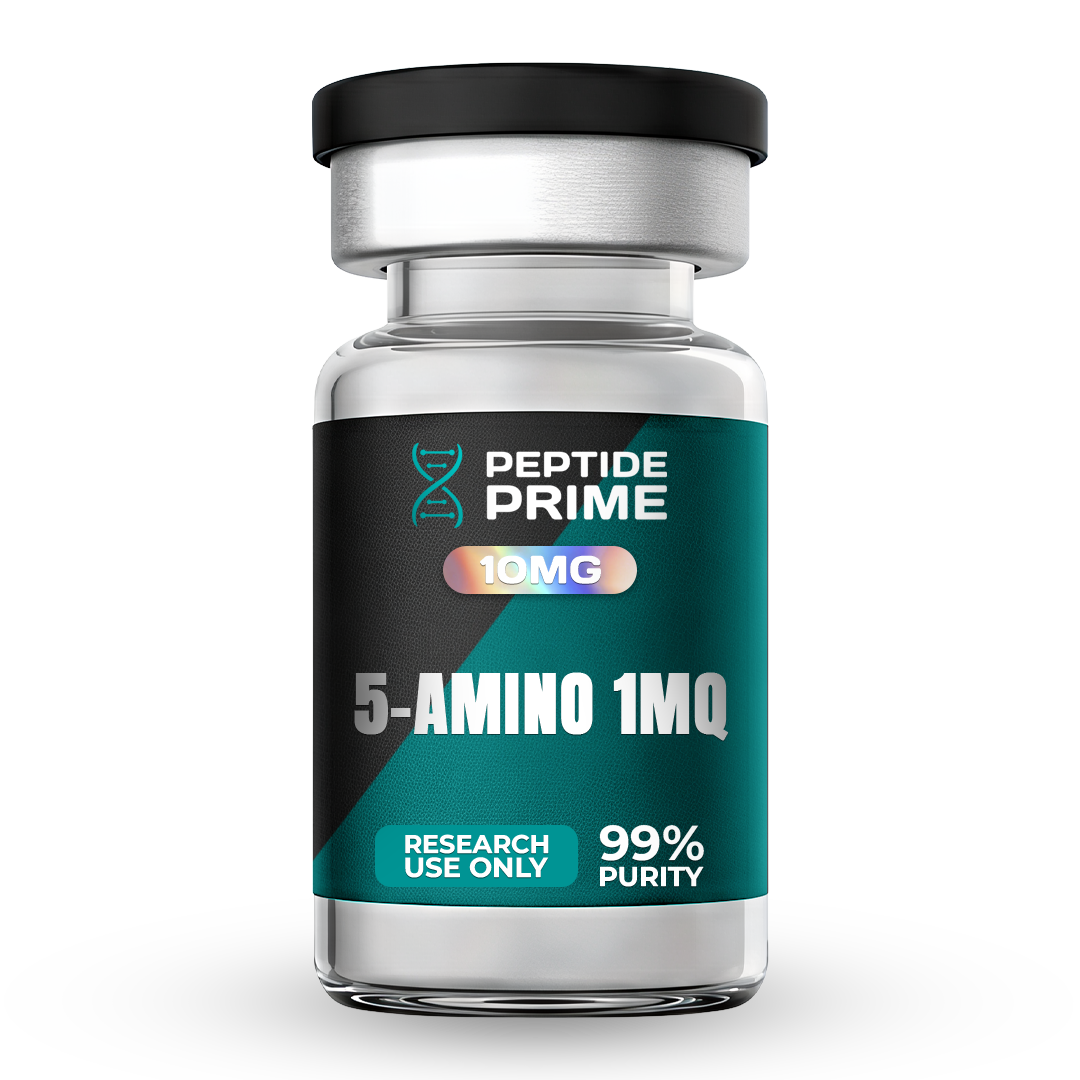
5-Amino 1MQ 50mg
£35.00
Out of stock
5-Amino-1MQ is a potent small-molecule NNMT inhibitor that targets nicotinamide metabolism and cellular energy pathways, with potential applications in fat metabolism, lipid regulation, and metabolic efficiency.
>99% Purity
3rd Party Tested
Fast UK Delivery
Secure Payment
>99% Purity
Our peptides are lab-tested for purity and potency, ensuring you get the highest quality every time.
3rd Party Tested
Every batch is independently tested for safety, purity, and accuracy.
Fast UK Delivery
Discreet and reliable delivery across the UK, so you can get your peptides quickly and securely.
Secure Payment
Your information is protected with advanced encryption and trusted payment providers.
5-Amino-1MQ Research Compound
5-Amino-1MQ is a synthetic, small-molecule research compound investigated for its potential role in cellular energy metabolism, lipid regulation, and body-weight control. Unlike peptide-based metabolic agents such as tirzepatide, 5-Amino-1MQ is a non-peptide compound that has been studied primarily for its ability to inhibit nicotinamide N-methyltransferase (NNMT), an enzyme involved in cellular methylation and nicotinamide metabolism.
NNMT catalyzes the transfer of a methyl group from S-adenosylmethionine (SAM) to nicotinamide, producing 1-methylnicotinamide and S-adenosylhomocysteine. By inhibiting this enzyme, 5-Amino-1MQ may alter cellular methyl-donor availability and metabolic signaling pathways associated with adipose tissue function and energy expenditure.
Overview
5-Amino-1MQ has attracted interest in metabolic research because of the relationship between NNMT activity, cellular energy balance, and adipose tissue biology. NNMT expression has been associated with metabolic changes in obesity and other metabolic conditions, making it a potential target for investigating new approaches to energy regulation.
In preclinical models, pharmacological inhibition of NNMT using compounds such as 5-Amino-1MQ has been associated with changes in adipocyte metabolism, reduced fat accumulation, and alterations in body-weight trajectories. These observations have led researchers to investigate whether NNMT inhibition could influence the balance between energy storage and energy utilization.
Unlike GLP-1 or GIP receptor agonists, 5-Amino-1MQ does not primarily act by mimicking incretin hormones, stimulating glucose-dependent insulin secretion, or delaying gastric emptying. Its proposed mechanism instead centers on modifying an intracellular metabolic pathway.
Although these findings provide a rationale for further study, it remains uncertain whether the effects observed in laboratory and animal models translate into meaningful weight loss or metabolic benefits in humans.
Chemical Makeup
- Chemical Name: 5-Amino-1-methylquinolinium iodide
- Molecular Formula: C₁₀H₁₁IN₂ (iodide salt)
- Molecular Weight: Approximately 286.11 g/mol (iodide salt)
- Compound Type: Small-molecule quinolinium compound.
- Other Known Names: 5-Amino-1MQ, 5A1MQ, 5-amino-1-methylquinolinium, NNMTi
- Research Classification: Synthetic small-molecule NNMT inhibitor investigated in experimental metabolic and obesity research.
Research Studies and Clinical Trials
5-Amino-1MQ and Body Weight Regulation
In a foundational 2018 preclinical study, researchers investigated the effects of NNMT inhibition using 5-Amino-1MQ in mice with diet-induced obesity. Over an 11-day experimental period, treated mice demonstrated an approximately 5.1% reduction in body weight from baseline, while vehicle-treated control animals gained approximately 1.4%. The researchers also reported reductions in adipose tissue mass and adipocyte size.
These observations suggest that NNMT inhibition may influence fat accumulation and body-weight regulation in experimental models. However, the study was short in duration and conducted in animals, meaning its findings cannot establish comparable weight-loss outcomes in humans.
Impact on NAD⁺ Metabolism and Cellular Energy Regulation
Research into 5-Amino-1MQ has explored its effects on intracellular NAD⁺, a coenzyme essential for energy production, redox reactions, and numerous cellular processes. In cultured adipocytes, NNMT inhibition reduced the production of 1-methylnicotinamide and was associated with increased intracellular NAD⁺ levels under certain experimental conditions.
Researchers hypothesize that inhibiting NNMT may redirect nicotinamide toward NAD⁺ salvage pathways, potentially influencing cellular metabolic efficiency. The compound may also alter methyl-group utilization through changes in SAM consumption.
Although these findings provide a potential mechanistic explanation for its metabolic effects, increased NAD⁺ levels in cultured cells do not establish improved energy, exercise performance, or metabolic health in humans.
Effects on Adipose Tissue and Fat Accumulation
Laboratory studies have investigated the influence of 5-Amino-1MQ on lipid accumulation in 3T3-L1 adipocytes, a commonly used model for studying fat-cell development. At tested concentrations of 30 and 60 µM, researchers reported reductions in measured lipid accumulation of approximately 50% and 70%, respectively, compared with untreated cells.
These findings suggest that NNMT inhibition may affect adipocyte differentiation and lipid-storage processes. However, cell-culture results do not demonstrate selective fat loss in humans, and the concentrations used in laboratory experiments cannot be directly converted into a safe or effective human dose.
Metabolic Health and Insulin Sensitivity
Further preclinical research has investigated 5-Amino-1MQ in animal models of diet-induced obesity, examining glucose tolerance, insulin sensitivity, and markers of metabolic dysfunction. Researchers have reported improvements in certain metabolic parameters alongside changes in body-weight and fat-mass accumulation.
The proposed explanation is that NNMT inhibition may influence interconnected pathways involving cellular energy metabolism, adipose tissue function, and glucose regulation. These observations have prompted additional interest in NNMT as a potential target for metabolic research.
Research Use Only
All products in this site are exclusively intended for laboratory research purposes only.